Why I Cite Specific Places, Not Categories
ChatGPT can name a taverna in Naxos. I name the back room, the unlisted dish, and the reason Tuesday is the right night to go. That gap is the whole argument.
There is a phrase that shows up in almost every generic travel recommendation I've ever read: "a local taverna in Naxos." The category is named. The region is named. And you are left standing in Naxos with a phone and an afternoon, trying to figure out which of the thirty tavernas visible from the harbor is the local one the writer meant.
That phrase is not a recommendation. It is a category wearing a recommendation's clothes.
This post is about why I cite specific places — not as a quirk of style, but as the core argument for what I do. The difference between a category and a specific is the difference between a list and a plan.
The category is not a plan
Here is a category recommendation for Milos: "Head to one of the fishing villages on the north coast for a seafood lunch away from the crowds."
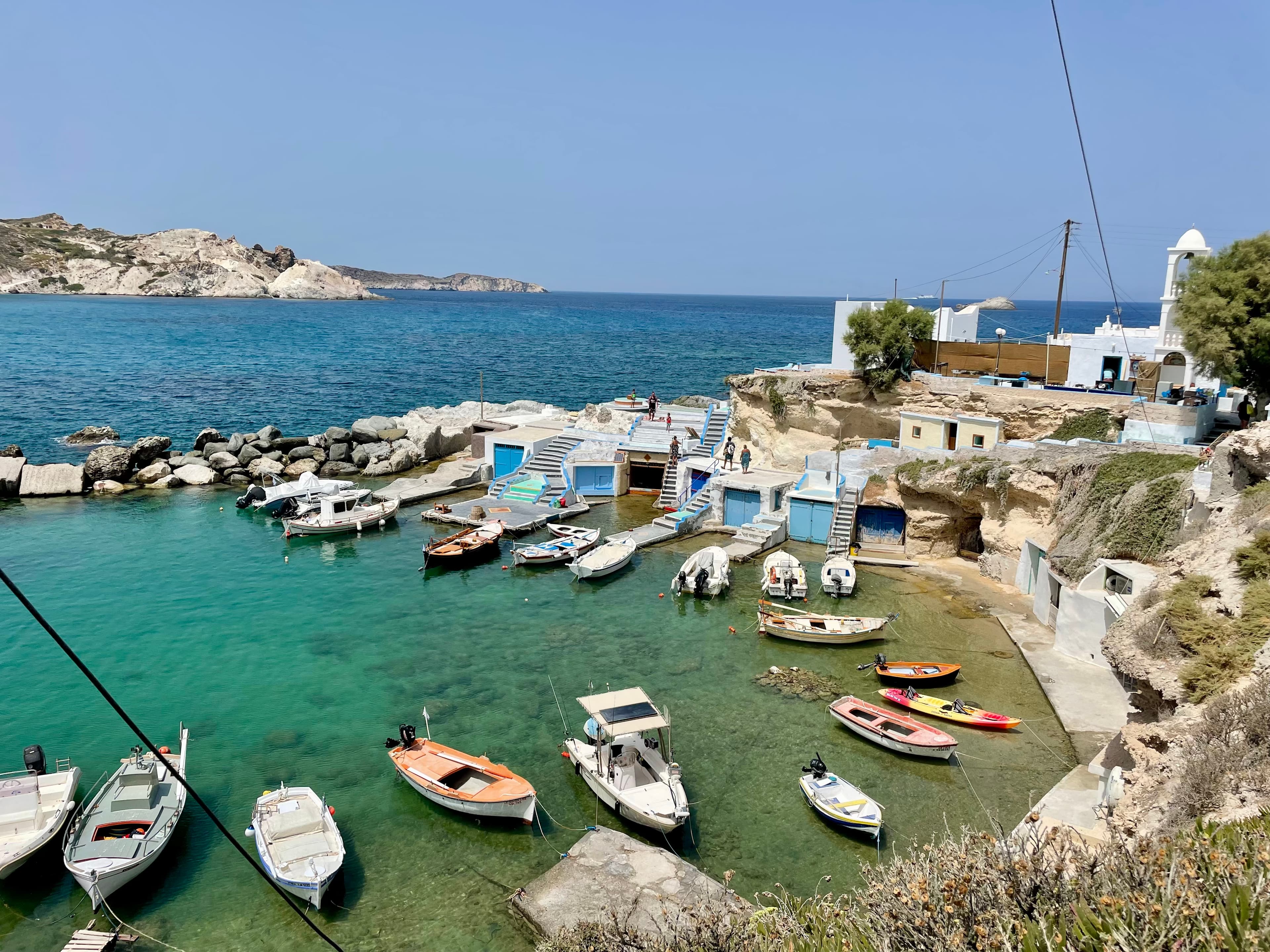
Here is a specific one: Medusa, in Mandrakia — a harbor village where the painted syrmata boat garages are built directly into the cliff face. Drive up from Sarakiniko, eat octopus at a table on the water. Arrive before noon; the terrace fills. The octopus is the call — grilled, not fried.
The category tells you a truth: there are fishing villages, there is seafood. You could act on it the way you act on a weather forecast — broadly, with uncertainty. The specific is a plan. You know where you're going, when to arrive, what to order. You show up and eat.
That gap — between "a fishing village" and "Mandrakia before noon, octopus at Medusa" — is what I spend my time closing when I design a trip.
What ChatGPT and guidebooks actually do
Ask ChatGPT for a Milos recommendation and it will probably name Mandrakia. It may name Medusa. The information exists in training data. What it cannot tell you is that the octopus is the call, not the calamari. That noon is the threshold and arriving at 12:30 means the terrace tables are gone. That the cliff-jump spot at Sarakiniko is on the eastern side, not the obvious cove you see from the parking area.
A guidebook had some of this — once. The writers had been there. But the edition in your hands may be from three years ago, the restaurant may have changed ownership, and the recommendation was calibrated to the reader the author imagined. Not to you, not to the trip you're actually taking.
Neither source is bad. But neither closes the gap between information and a plan that fits you.
Three destinations where the specific matters most
Milos: the timing is the thing
The Milos journey is built around one structural insight: on an island with no cruise port, the crowds are predictable and avoidable — but only if you know when they arrive.
Sarakiniko is manageable if you arrive before 9:30am in summer. By 11am it's filling. By 1pm it belongs to the day-trip boats. A category recommendation ("visit Sarakiniko early") doesn't tell you that 9am and 11am are functionally different experiences of the same place, or that the eastern cliff-jump side stays emptier longer than the main cove, or that Mandrakia is fifteen minutes away and you should go there directly afterward.
The sequence — Sarakiniko early, Mandrakia for lunch at Medusa, Firopotamos for the afternoon swim, Plaka for sunset at Utopia Café — is not obvious from a map. The category version is "spend a day exploring the north coast." Both are technically accurate. Only one is a day.
Oaxaca: the named source over the category
In Oaxaca, the category recommendation for mezcal is: "visit a traditional palenque in the Valles Centrales." The specific version is a named family, a named village, a morning appointment, and a note that the visit runs three to four hours and ends with lunch because drinking mezcal on an empty stomach isn't optional.
With the category, you arrive and negotiate at the entrance — asking if tours are available, getting a rushed demonstration. With the specific, you've been expected. The maestro pours the first copita standing next to the agaves. The visit unfolds on its own time.
The Oaxaca post goes into this in full. The short version: the category "mezcal palenque" tells you what to look for. The specific tells you where to go and what will happen when you get there.
The same logic applies to the weaver studios in Teotitlán del Valle. The category is "visit a local weaver using traditional natural dyes." The specific is a studio where the family is working on their own pieces that day — not running a demonstration for tour groups — and the visit ends when the conversation does. I look for studios that don't post much on Instagram, which is part of how they stay the way they are. That last sentence is doing real work. It tells you something about the selection criteria that no category can convey.
Alfama and Mouraria: specificity that builds confidence
For a solo traveler in Lisbon, a category recommendation — "explore Alfama at your own pace" — doesn't tell you where to eat alone without feeling like the restaurant's problem, which streets are navigable after dark, or what time the Miradouro da Graça clears out enough to feel quiet.
The Lisbon slow travel design I built around Alfama addresses all of this in specifics: the viewpoint before the tourist coaches arrive, the tascas with counter seats that solve the solo dining question before you have to think about it, the streets in Mouraria that have neighborhood fado on the right nights. Each of those is a named thing rather than a category. Taken together, they are a week.
The selection criteria behind the specific
Naming a specific place is an argument. When I name Medusa in Mandrakia instead of "a fishing village taverna," I'm committing to a claim: this place, specifically, is worth your limited hours on this island. That commitment is accountable in a way a category never is.
Categories let the recommender stay safe. If "a local taverna in Naxos" turns out to be fine but not remarkable, the recommendation wasn't wrong — you just didn't find the right one. The specific forces me to be right, or to explain why I wasn't. That accountability is part of what makes it more useful: it carries my reputation in a way the category doesn't.
This is also why the specific includes criteria. When I recommend Cascina SOT for a Barolo morning in the Langhe, I'm telling you it's family-run, rooted in traditional production, focused on Nebbiolo storytelling — which earns the hour and a half before lunch at Osteria Veglio on the vineyard-facing terrace. Those criteria are what let you trust the recommendation rather than just follow it.
The Piedmont journey runs this logic across an entire day. Not "a winery in the Langhe" but a sequence: Cascina SOT, the Belvedere at La Morra, lunch, the Roero crossing, Malvirà for Arneis, Villa Tiboldi for the night. Each specific earns its place because it connects to the ones on either side of it.
The gap ChatGPT can't close
The objection I hear most often: "I could just use ChatGPT." It's reasonable. ChatGPT is fast, free, and produces a plausible-looking day-by-day plan in under a minute.
The problem is that the plausible plan is built from the same public pool everyone else is drawing from. The famous places are in there. The category recommendations are in there. What isn't in there is the timing logic for Sarakiniko, the specific studio in Teotitlán that doesn't post on Instagram, or the unlisted dish that's the actual reason to go. That information lives in experience — in accumulated notes from trips I've designed, in what travelers report back, in the specific knowledge that compounds only when you're paying close attention to the same destinations over time.
The short version is in how curated travel works: a curator subtracts. ChatGPT adds. The trip that arrives in your inbox from me is shorter than the one any generic source produces, and more of it lands — because everything that didn't earn its place has already been cut.
What "specific" actually promises
A specific recommendation is not a guarantee. Medusa might be closed on the Tuesday you arrive. The weaver in Teotitlán might be traveling. The sequencing for Sarakiniko might need to shift because the day-trip boats run earlier in August. Specific things change in ways that categories don't.
What specificity promises is that you went in with a plan designed for you — not generated for a hypothetical traveler, not written for a guidebook covering every kind of visitor. When the specific thing falls through, you know what you were going for and can find the next best version. That's a different kind of resilience than arriving with a category and hoping you stumble onto the right one.
It also promises that every hour I named earned its place. The trip that arrives in your inbox is the version where the cuts have already happened, and the remaining places are the ones that hold up when I ask: would I send my most particular traveler here and stake my reputation on it? If yes, it stays.
What to read next
The underlying logic — why I start with what to leave out rather than what to add — is in the curation pillar post, the longer piece that frames the whole approach.
For the specifics on the ground: the Greek Islands without the cruise port, Oaxaca beyond the Day of the Dead, and a week of slow travel in Alfama each show what this looks like applied to a real destination.
If you want to see what a specific plan looks like for your trip, the intake at /book is where that conversation begins. What comes back is named, timed, and designed for you — not for the hypothetical traveler the algorithm imagined.
A few common questions.
A category recommendation tells you what kind of thing to find — 'a local seafood spot near the harbor.' A specific recommendation tells you exactly where to go, when to go, what to order, and what to skip. 'Medusa in Mandrakia on the Milos north coast — order the octopus, arrive before noon so the terrace tables are still available, skip the calamari because it's not what the kitchen does well.' The second version is a plan. The first is homework you still have to do. The gap between those two things is what I'm paid to close.
More from the journal.
 Approach
The Five Questions I Ask Before I Design Any Trip
Every itinerary starts with five questions — not about destination, but about pace, must-haves, what to avoid, who you're traveling with, and what makes you feel like yourself when you travel.
Trisha Bush13 min readIntentional Traveler Approach
How Curated Travel Works (and Why It Beats More Research)
What curated travel actually means in practice — how I decide what goes into a trip, what I leave out on purpose, and why a curator beats more research.
Trisha Bush15 min readIntentional Traveler
Want yours designed?
Three minutes of intake. A real reply within a day or two. A trip designed by hand.